Frequently asked questions
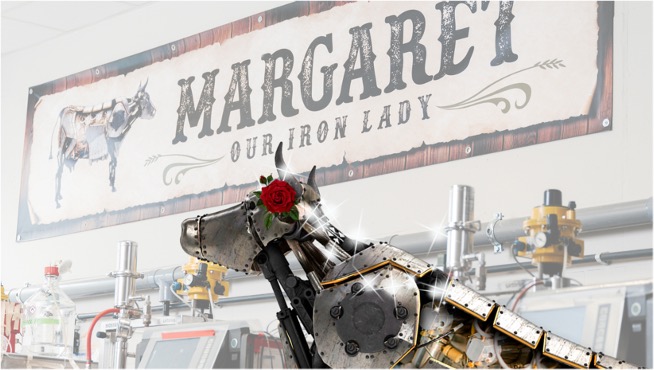
As the original Stainless Steel Cow and First Lady of our herd, Margaret is the one us lab cowboys work tirelessly for. Although *very* high maintenance, she inspires and motivates us.
On her behalf, we answer any ol’ questions you folks might have on her mysterious ways. Is your question not answered? Feel free to contact us
General FAQs
What about farmers?
Growing into a truly sustainable, healthy food system, we’re going to need more farmers, not less. Because the old system of a few great players monopolizing food, and livestock farming ever increasing in scale, hoarding the natural land is teetering on its last legs. Organic, plant-based, local farming, on a healthy, human scale is the way forward.
We have good reasons to aim for grass as Margaret’s primary food source. Grass doesn’t need a lot. It grows well in most places and keeps the land in the hands of our grassland farmers.
The nice thing is, talking farmer to farmer we have good conversations – very different from the polarized impression you might get from the news. We’re mostly met by forward thinkin’, genuinely interested minds, curiosity and, of course, a healthy dose of skepticism. As it should be.
What does Big Dairy make of all this?
Traditional players in the dairy biz are mostly genuinely interested, open and curious about Margaret. We already have some cool collabs goin’ on.
Is this GMO or non GMO?
Margaret’s cheese contains no GMO (genetically modified organisms). The microbes that make casein (cheese protein) get a little backpack of synthetic cow’s DNA (no cows involved), but they don’t end up in Margaret’s cheese – just like a cow doesn’t end up in a glass of milk.
So, it’s no GMO product and will not be classified as such. It is considered a novel food though and is thoroughly tried, tested and checked as we speak.
Will it be healthier than cow’s cheese? Suitable for lactose intolerance/folks with cow’s milk allergy?
The stainless steel cow opens doors to better nutritional value than cow’s cheese. You can keep what you like (protein, healthy fats, big taste) and leave out the rest (saturated fats, lactose, hormones intended for a growing calf).
Note: People allergic to casein might have the same reaction to our cheese. For now, we only know it’s lactose free.
Do we need to eat cheese at all?
A simple plant-based, organic diet with plenty of seeds, nuts, pulses, grains, fruit & veg would do the job, we think. And sure, nuts are nice, but cheese just tastes amazing. We’re working on a way to have that treat in a healthy way for everyone involved (including cows, calves & the rest of the planet). With our casein, we can just keep enjoying cheese.
What is stainless steel cow’s cheese made of?
Our Stainless Steel Cow provides casein, the essential milk protein. To this casein, some microbial rennet is added, as is the case in most cheeses today, plus some salt, water, cultures for blue, red rind or white rind etc., and plant-based or microbial fat. In short, the same ingredients as animal based cheese. We’re trying out which kinds of fats works best to make the cheese super creamy. One of the perks of this production process is, that you can choose to make it as healthy as possible: you can keep the good stuff and leave out what you don’t want or need.
What kind of sorcery is this?
Although with pretty fancy results, the basic production process behind our casein (essential milk protein) is fermentation. Just like beer, yogurt, pickles etc.
A stainless steel cow? What, why?
80% of our farmland today is dedicated to livestock, and we’re running out of planet. Our stainless steel cow Margaret does the job 5x more efficiently than her sentient sisters. She’s the next logical step in a world that will soon need to feed 10 billion people – who would still like nice cheese on their pizza’s & charcuterie boards.
Crowdfunding
On crowdfunding & investing
- What is the difference between participating in the crowdfunding and investing as a shareholder?
- Is it possible to buy shares, what is the price per share, and is there a minimum investment?
- Which crowdfunding platform will be used, and where can interested parties find more information?
By joining this crowdfunding round, participants become shareholders in Those Vegan Cowboys, under the same terms as existing shareholders in this round.
Participation takes place via a STAK (Stichting Administratiekantoor) structure, with a minimum investment of €250. The crowdfunding will be hosted on the Invesdor platform, where further details will be shared in due course.
On long-term vision & independence
- What is the long-term business vision of Those Vegan Cowboys?
- How do you view (early) acquisitions by large food companies, and how do you safeguard your mission and impact?
We firmly believe this transition can only be made together with the traditional dairy industry, retailers, and the wider value chain. This is not a solo ride.
In the years ahead, we will focus on building strong partnerships across the chain, bringing retailers and suppliers closer together. Our ambition is scale, because scale equals impact. We dream of taking the cow out of the chain of mass produced pizza cheese and burger slices across the world.
We would only consider an acquisition if we were fully convinced it would increase our positive impact for animals and for the natural world. That principle is deeply rooted in our company DNA and shared by our shareholders. It remains the compass for every major decision we make.
The beauty of our model is that impact is built directly into the product. The further we ride, the greater the impact. The better we perform financially, the better it is for animals and nature. It makes for a truly unique investment where success and impact are fully aligned.
When can we buy it? What does the roadmap to market introduction look like?
We have secured self-affirmed GRAS status in the United States, which allows us to enter the market there. Full regulatory approval is expected over the year.
We can also move relatively swiftly into Singapore, and we anticipate entering the European market within three to four years.
Rest assured we’re working hard as we can to speed things up, both as lone cowboys and in a team effort with fellow companies as Food Fermentation Europe!
I want to try! When and where will it be possible to taste the product for the first time?
In the Netherlands, we are working on our first official tastings this year, in 2026. Under specific conditions, we are already able to host limited tastings at our lab. We gotta ask y’all to hold your horses though: interest has been strong, the waiting list is long, so not everyone will be able to saddle up at once. We sure hope to extend invitations to our complete circle of friends (including you) asap, but this will take some time.
Will you make all kinds of cheese or only specific ones?
Margaret’s casein forms the foundation for every and any kind of cheese. From beautifully creamy mozzarella to bold, flavor-packed pecorino-style hard cheeses.
Our long-term ambition is to enable all cheeses to be made with microbial casein. Just as 95% of all cheeses today already rely on microbial rennet (or Aunt Rennet as we like to call her – say hi below).
In-house at Those Vegan Cowboys, we’re actively developing mozzarella and burger cheeses, and we’ve already enjoyed successful versions of camembert and feta. In parallel, we supply our casein to cheese producers who incorporate it into cheeses that have been established on the market for many years.
On competition
- How does Those Vegan Cowboys position itself relative to competitors in precision fermentation and alternative proteins?
- What sets you apart from other players and why are you the best investment in this space?
Luckily, we’re not the only riders on this trail. Precision fermentation has been around for some time: animal-free rennet is a good example. A growing number of companies are now applying it to protein production.
Most of those players focus on whey protein. Whey is a strong, versatile protein that performs well in products like yogurt or ice cream. But when it comes to making real cheese, whey won’t go all the way. For that, you need casein.
Casein is a tougher beast to tame. From a technical standpoint, it’s more complex to produce. From an impact standpoint, it’s the holy grail of making cheese truly animal-free and sustainable. That’s where our focus lies.
There are only a handful of companies worldwide that genuinely concentrate on casein and are already able (like we are) to deliver it at scale. Each of these companies is taking a slightly different route. Ours is clear: we focus on highly functional casein proteins that not only match animal-derived casein, but ultimately outperform it and can be produced at lower cost.
As far as we’re concerned, system change doesn’t happen with a lone cowboy. The trail ahead is wide enough for more riders. In fact, it needs them. Meeting the enormous global demand for sustainable dairy will require many more companies like ours, all workin’ on the same mission.
On technology, IP & Is This Cheese?
- Is Margaret’s technology protected through patents or other forms of intellectual property?
Yes, we hold a substantial and steadily growing portfolio of patents. These cover both how we produce our casein and how we turn it into cheese, meaning our technology is well protected and not easily copied by anyone riding a little too close to our trail.
- Is This Cheese? In other words – will you be legally allowed to call Margaret’s product “cheese” under current regulations?
Whether our customers can legally call their end products “cheese” depends on several factors, including the additional ingredients used and the jurisdiction in question. This is still a new stretch of terrain, so it remains an ongoing conversation with regulators.
What’s clear to our customers, both in and beyond the traditional dairy industry, is that they want to call it cheese. Because, quite simply, that’s what it is.
On market, product & applications
- Who is the primary target market for your casein: consumers, foodservice, or B2B (business to business) ingredients?
- Do you collaborate with other food producers (such as pizza, meat alternative, or snack manufacturers)?
- How important is price parity or a lower cost than conventional cheese as an ingredient, and is that achievable in the long term?
Our first stop on the trail is firmly B2B. We supply casein to producers such as cheesemakers and chocolate manufacturers, who then bring the finished goods to consumers.
Further down the road, we will also launch our own high-end products. That said, we aim for maximum impact: scale matters most. That is why we want to top burgers and pizzas everywhere.
At the time of writing, we are riding alongside around ten partners across cheese, chocolate, sports nutrition, pizza, and even adhesives, with more joining all the time. Several of these partners are now moving from testing into upscaling.
Price, alongside taste and functionality, is a decisive factor. We expect to supply our casein at a commercially attractive price point within approximately six years. In some applications, our casein already performs better, meaning less is needed to achieve the same (or better) results.
In the long run, we expect to reach price parity. That said, our customers are currently willing to pay a premium because of the clear advantages, particularly in terms of CO₂ reduction. With sustainability regulations tightening, especially in cheese and chocolate, taking the animal out of the equation (even partially) is becoming less of a choice and more of a necessity.